


If you search for “the best education system in the world,” you will likely find a dozen different answers. Some reports say the United States, others insist it is Finland, and many point straight to Singapore.
So, who is actually telling the truth?
The reality is that there is no single “No. 1” country for education. The answer completely changes depending on how you measure success. Are we looking at standardized test scores for 15-year-olds, the global prestige of universities, or the overall well-being and stress levels of the students?
To give you a real answer, we have to break down the global education rankings into three distinct categories: K-12 academic performance, higher education, and holistic learning.
1. The Standardized Testing Champion: Singapore
If we are strictly looking at K-12 public schooling and raw academic achievement, Singapore is definitively No. 1.
The global benchmark for public education is the PISA (Programme for International Student Assessment) test, which evaluates 15-year-old students across dozens of countries every few years. In the most recent PISA results, Singapore completely dominated the charts, securing the number one spot globally in all three core subjects: Mathematics, Reading, and Science.
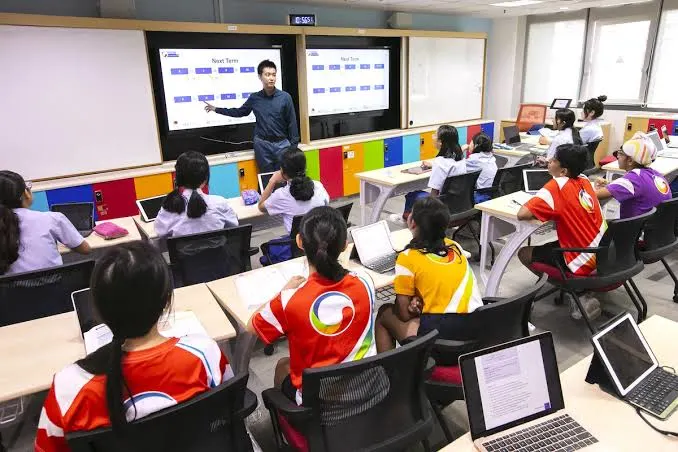
Singapore’s success comes down to a highly structured curriculum, deep investments in teacher training, and a national culture that places an immense value on educational merit. Their approach to teaching mathematics—often called “Singapore Math”—focuses heavily on problem-solving and conceptual understanding rather than simple memorization, and has been adopted by schools worldwide.
also read : – Top 10 Toughest Languages to Learn: What You Need to Know!
Other top K-12 contenders: Japan, South Korea, and Estonia.
2. The Higher Education Powerhouses: USA & UK
If you shift the focus away from high schools and look at universities and research output, the ranking changes dramatically. For higher education, The United States and the United Kingdom share the crown.
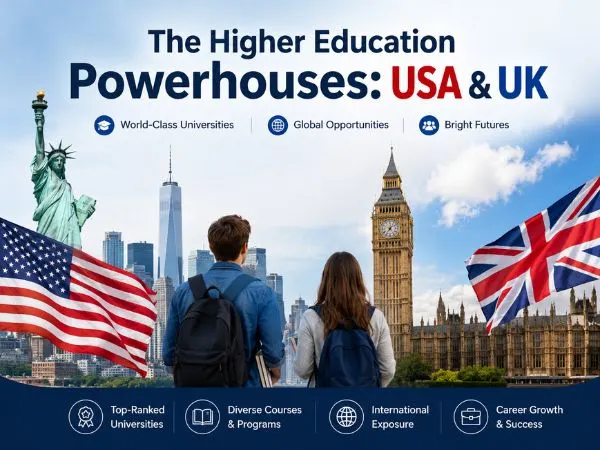
When publications like U.S. News & World Report or the QS World University Rankings list the best countries for education, the US and UK consistently take the top spots.
Why? Because they are home to the vast majority of the world’s elite, globally recognized institutions.
- The United States: Boasts Ivy League institutions like Harvard, MIT, and Stanford. It leads the world in academic research funding, technological innovation, and attracting international students.
- The United Kingdom: Home to historic giants like Oxford, Cambridge, and Imperial College London. The UK is highly regarded for its rigorous academic standards and producing world-leading research.
While basic public education in the US varies wildly by state and zip code, its university system remains the global gold standard for research and career networking.
3. The Holistic & Well-Being Model: Finland
What if the “best” education system isn’t the one with the highest test scores, but the one that produces the happiest, most well-rounded students? By that metric, Finland is widely considered No. 1.
For decades, Finland has fascinated global educators because they achieve excellent academic results by doing the exact opposite of high-pressure systems like those in East Asia.
The Finnish education model is built on equity and well-being:
- There are virtually no standardized tests until the end of high school.
- Students have significantly less homework and shorter school days.
- Teachers are highly respected, requiring a master’s degree to enter the profession, and are given immense autonomy in their classrooms.
- Playtime, outdoor activities, and the arts are prioritized over rote memorization.
Finland proves that you do not need to subject children to immense academic stress to build a highly literate, educated, and functional society.
also read : – Top 15 Hardest Degree in the World – What factors should you consider when deciding on a degree?
The Final Verdict
So, what country is No. 1 in education?
- If you want the smartest 15-year-olds in math and science: Look to Singapore.
- If you want to attend a world-renowned university: Look to the United States or the UK.
- If you want a stress-free, highly equitable system: Look to Finland.
Frequently Asked Questions (FAQ)
What is the PISA test and why does it matter?
PISA stands for the Programme for International Student Assessment. Run by the OECD, it is a global exam given to 15-year-old students to measure their reading, mathematics, and science literacy. It is widely considered the most accurate and objective benchmark for comparing the quality of K-12 public education systems across different countries.
Why doesn’t the United States rank number one in K-12 education?
While the US dominates in higher education, its K-12 public school system is highly decentralized and largely funded by local property taxes. This creates significant inequality. Schools in wealthy neighborhoods often perform at world-class levels, while underfunded districts struggle, which brings down the country’s overall national average in global rankings.
Is the education system in Finland really as stress-free as people say?
Yes, the Finnish model is fundamentally different from most of the world. They prioritize equity, student well-being, and play over standardized testing and homework. While they may not always take the absolute #1 spot in raw math scores anymore, their students consistently perform exceptionally well while reporting some of the lowest levels of academic anxiety in the world.
Does a country’s education ranking affect its economy?
Absolutely. Countries that invest heavily in high-quality education and rank well globally tend to have stronger, more innovative economies. A highly educated workforce attracts global businesses, drives technological advancement, and generally leads to a higher standard of living for its citizens.
Which country is best for international college students?
For higher education, the United States, the United Kingdom, Canada, and Australia are consistently ranked as the top destinations. They offer globally recognized degrees, massive research budgets, and diverse campus environments that are welcoming to international students.